Base
Immutable trusted core
The system image is read-only by default, reducing drift and preserving integrity.
Warning: Avyos is experimental alpha software and is not ready for production use. Use only in testing or non-critical environments.
Avyos is built in Go on top of Linux primitives. It rethinks the system layer for clarity, stronger isolation, and long-term maintainability without carrying legacy Unix assumptions forward.
Built for teams that value clarity, reliability, and operational confidence.
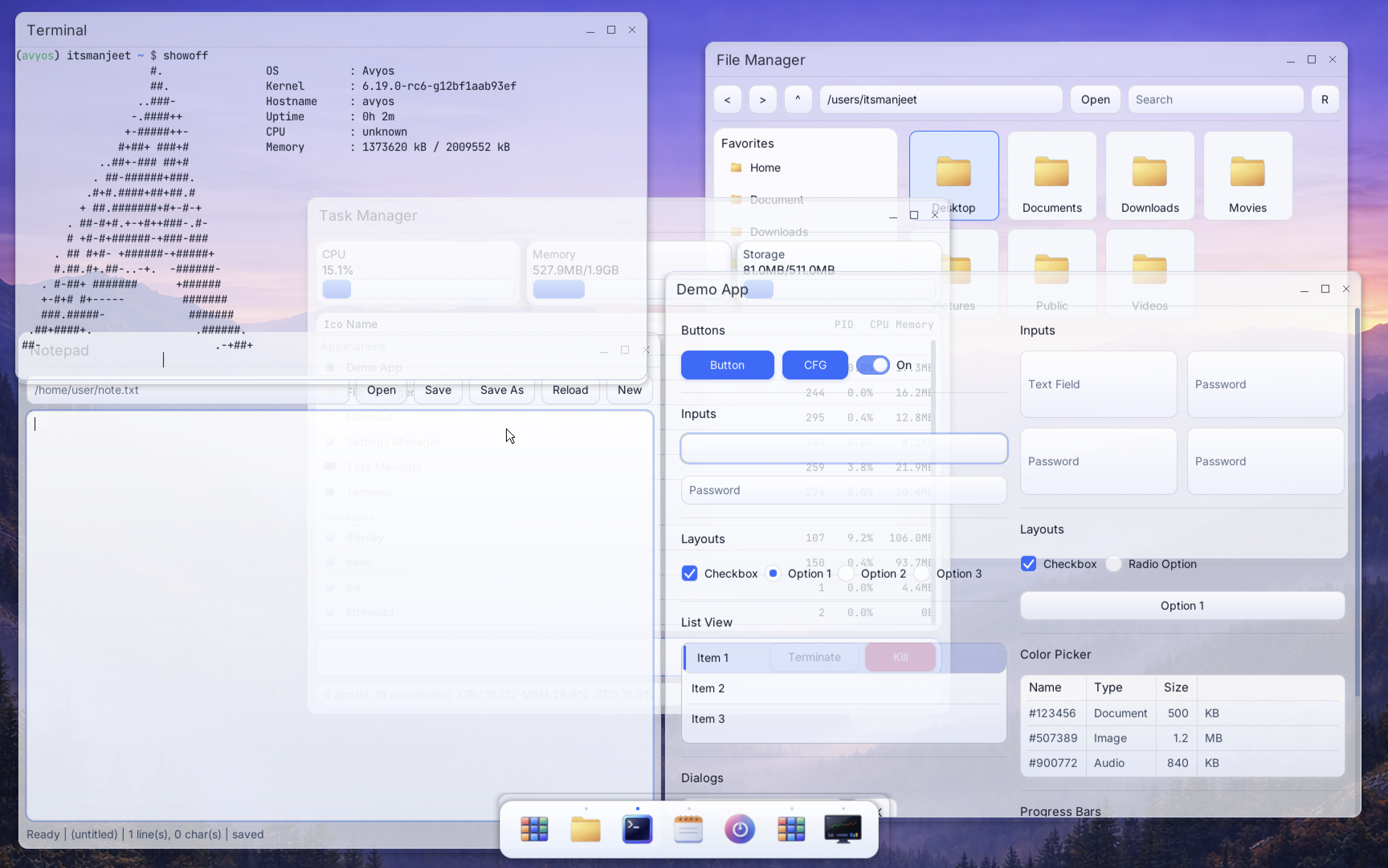
Desktop Preview
Early Avyos desktop preview.
Avyos starts with a clean model where trust, identity, and lifecycle behavior are intentional from day one.
Predictability is the baseline. If behavior is unclear, redesign it.
A clear system model focused on reliability, security, and maintainability.
The system image is read-only by default, reducing drift and preserving integrity.
The platform separates foundational system behavior from operational change.
Authorization is explicit, composable, and designed around least privilege.
Apply updates atomically and roll back quickly when verification fails.
Telemetry is disabled by default, and diagnostics remain transparent and opt-in.
Fewer base services improve auditability and reduce operational surprises.
Run existing Linux applications in isolated environments while keeping the core platform independent.
"Security and reliability should emerge from design, not from patchwork."
Architecture principleSecurity is designed in from day one, not added later.
Core system components stay read-only, and changes remain intentional and reversible.
Capabilities define what software can do, replacing broad roles with focused permissions.
Service and app boundaries are explicit, keeping behavior understandable and enforceable.
Clear answers to common questions.
Avyos is built in Go above Linux primitives with modern identity, predictable lifecycle behavior, and clear compatibility boundaries.
Implementation policy:
Keep the full system in pure Go with CGO_ENABLED=0. Prioritize a design that is simple to
develop, maintain, and use. Compatibility-layer distro resources are allowed, but must stay optional and
never become a hard dependency for core platform behavior.
Reference architecture
Trusted boundaries and runtime contracts from kernel to user-facing workloads.
Distro compatibility runtime in strict isolation, with no access to the outside host environment. Privilege: Isolated
User-facing apps and sessions with constrained access to platform services. Privilege: User
Shared runtime services for graphics, display, and session orchestration. Privilege: Service
Platform control services for boot, policy, identity, and lifecycle management. Privilege: Platform
Kernel primitives and hardware control for process, memory, and network boundaries. Privilege: Kernel
v0 release scope
Start with docs, review the architecture, or contribute implementation work.
Spin up the latest Avyos image locally in minutes.
Notice: Below command take around 200 MB bandwidth and has been tested on macOS and Linux host machines.